
The Greensboro Massacre: Five Killed at an Anti-Klan Rally
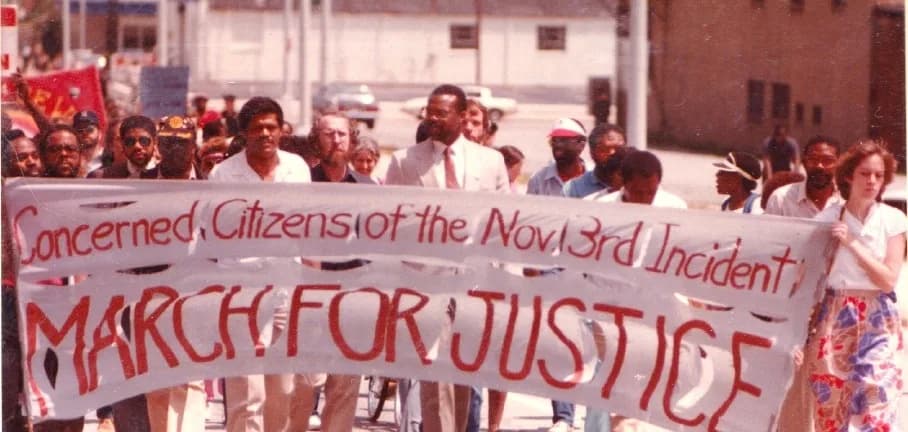
On November 3, 1979, members of the Ku Klux Klan and the American Nazi Party opened fire on an anti-Klan rally in Greensboro, North Carolina, killing five people. The verdicts that followed, and a later truth commission, made the case a landmark in the debate over accountability.
Published · Updated · 3 min read
A Rally in a Black Neighborhood
In the fall of 1979 a small Marxist–Leninist group called the Communist Workers Party planned a “Death to the Klan” march and rally in Greensboro, North Carolina. Several of its members worked in or organized around the region’s textile mills, and the group had already clashed publicly with the Ku Klux Klan. The gathering was set for the morning of November 3 at Morningside Homes, a public housing community with a largely Black population. The organizers had publicized the event and had provoked the Klan with taunts, which became part of the later argument about who bore responsibility.
Less Than Two Minutes of Gunfire
As marchers were assembling, a caravan of cars carrying Klansmen and members of the American Nazi Party arrived. Within moments shots were fired into the crowd, and the shooting lasted less than two minutes. Five people died: Cesar Cauce, Dr. James Waller, Dr. Michael Nathan, William Sampson, and Sandra Smith. Several others were wounded. A local television crew filmed much of the event, so the killings were seen widely. Police officers were not present at the moment of the attack, even though investigators later learned that the police had been told of the plan through an informant inside the Klan.
Trials and Verdicts
Six Klansmen and Nazis were tried on murder charges in 1980, and an all-white jury acquitted them. A federal trial on civil rights charges ended in acquittals in 1984. In 1985 the families of some victims brought a civil suit, and a jury found several of the defendants and members of the city’s police department liable for the wrongful death of Dr. Nathan, the only victim who was not a member of the party. The city paid damages in a judgment of several hundred thousand dollars. For many residents of Greensboro and for observers elsewhere, the criminal verdicts left a sense that justice had not been done.
A Commission and a Reckoning
In 2004 local residents created the Greensboro Truth and Reconciliation Commission, modeled on the one in South Africa and the first of its kind in the United States. After two years of public hearings it issued a report in 2006. It concluded that police had known white supremacists planned to attend the march and had failed to act, and it pressed for acknowledgment of the harm done. The city council was divided about the findings, and decades later it issued a formal apology. The events of that morning remain a reminder of the cost of political violence and of how a community can try to face a painful past.
Sources
Found an error? Send a correction. Read our editorial standards.