
The First Flight Around the World Returns to Seattle
On September 28, 1924, the Chicago and New Orleans returned to Seattle after completing the first aerial circumnavigation. A third plane joined the formation at the finish but had not flown the whole route.
Published · Updated · 3 min read
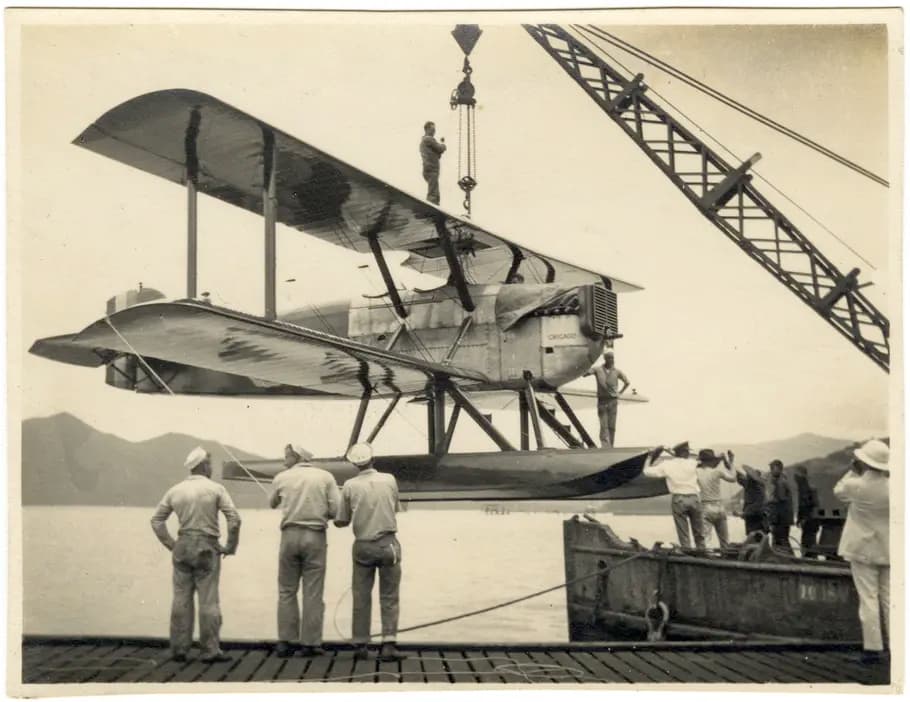
The Last Landing of a Very Long Route
On September 28, 1924, the U.S. Army Air Service's Chicago and New Orleans landed in Seattle after completing the first aerial circumnavigation of the world. A third airplane, Boston II, accompanied them on the last part of the journey but had not made the entire circuit. The finish brought the aircraft back to the city from which the expedition had departed in April. Around the world described the route completed over months of flying, not a nonstop performance. Every landing was part of the work that made the next stage possible.
Four Aircraft at the Start
The Army began with four Douglas World Cruisers named Seattle, Chicago, Boston and New Orleans. Their crews faced terrain and weather for which reliable forecasts and dependable airfields were limited. The planes could use wheels or floats according to the segment ahead. That flexibility meant more than carrying two possible kinds of landing gear: suitable equipment, fuel and people had to be available when needed. The route through the northern Pacific, Asia, Europe and the North Atlantic depended on advance arrangements with organizations and governments along the way.
Why Two Original Planes Were Lost
The Seattle crashed in Alaska, and its crew survived. The Boston was lost after a forced landing in the North Atlantic, and its crew also survived. A replacement, Boston II, rejoined the formation in North America. The distinction matters when identifying the aircraft in photographs of the return. An image showing three biplanes at the end does not demonstrate that three original airframes flew around the world. Chicago and New Orleans were the two that completed the circuit, although other crews and aircraft remained important to the expedition's story.
An Achievement Made on the Ground Too
The planes flew exposed routes with limited alternatives in case of engine trouble. Progress depended on ships, repair crews, local hosts and people able to move supplies to places that were often difficult to reach. Weather could turn a planned departure into a wait of several days. To cover the whole route, the expedition had to keep aircraft usable across repeated flights, salt water exposure and changes of landing surface. A record for the distance means little without that organization: the aircraft spent much more time being supplied, checked and held for weather than the finish ceremony suggests.
What the Seattle Return Proved
The achievement established that airplanes could be coordinated around a global route with enough preparation and support. It did not establish a regular airline service, and the losses illustrated how vulnerable long range flying still was. Both points can be seen in the surviving Chicago, preserved by the Smithsonian. Its modest size makes the map of the journey look more remarkable. The September arrival was a public celebration of flying, but the underlying accomplishment was keeping enough of an expedition working from one landing to the next until the circle closed.
Sources
Found an error? Send a correction. Read our editorial standards.