Breaking the Barrier: The Gamboa Dike Demolition of 1913
On October 10, 1913, workers blasted the temporary Gamboa dike during construction of the Panama Canal. Archival photographs preserve a dramatic engineering milestone before the canal’s later opening.
Published · Updated · 2 min read
An Engineering Milestone in Panama
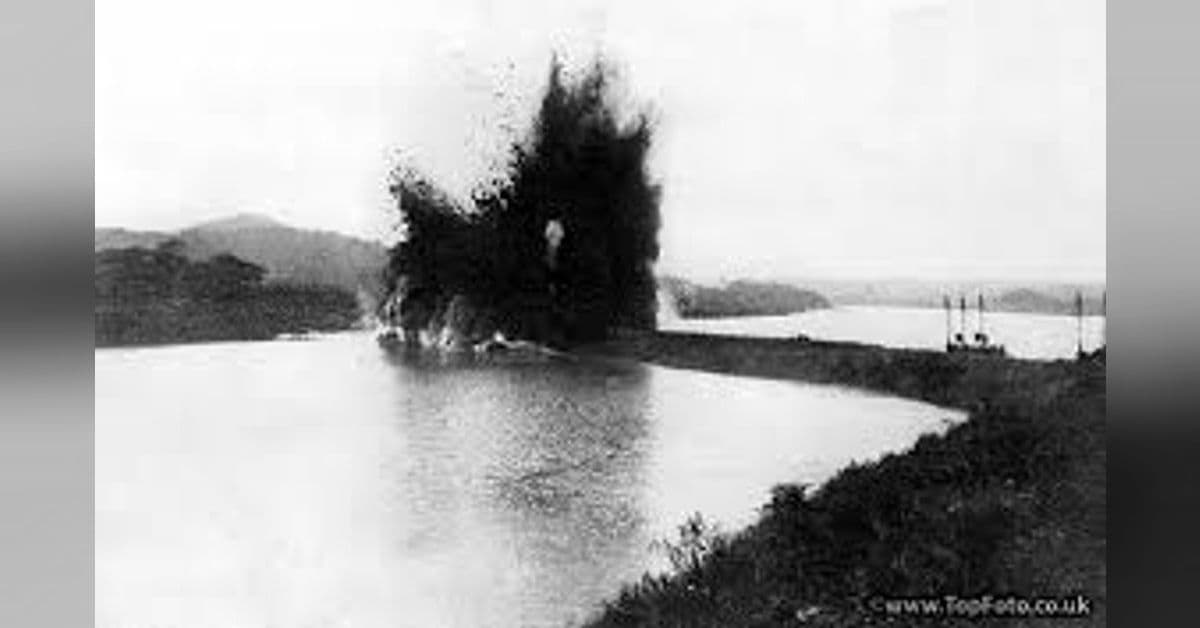
On October 10, 1913, a demolition blast broke the temporary Gamboa dike during construction of the Panama Canal. The event took place in Panama within the American-led canal project. It marked progress toward completing the waterway, rather than the beginning of commercial operations.
A Barrier Built to Be Removed
The Gamboa dike was a temporary earthen barrier used during construction. Unlike a permanent dam intended to retain water throughout its working life, this structure had to be removed as the project advanced. Its demolition illustrates how temporary works can be essential to building a permanent waterway.
The Blast Recorded in Photographs
The Smithsonian’s National Museum of American History holds photographs dated October 10, 1913, showing the demolition from different viewpoints. One record describes a view northward from a boat south of the dike; another identifies a view from a hill on its eastern side. Together, the records establish the date and offer different perspectives on the operation.
More Than One Explosion
A federal engineering history records the October 10 blast and notes that a second explosion demolished the eastern end of the earthen barrier six days later. The removal therefore should not be presented as a single instant in which every part of the dike vanished.
Construction Was Not the Same as Opening
Breaking the barrier was a construction milestone. It should not be confused with the canal’s later official opening or depicted as an immediate parade of commercial ships. A careful account distinguishes the removal of temporary works from the waterway becoming operational.
How to Recreate the Scene
An illustrative recreation can show the earthen barrier, observers at a safe distance, rising dust and water moving through the breached section. The archival photographs provide a stronger visual reference than a generic explosion. A realistic depiction should avoid an enormous fireball, a towering tsunami or machinery from a later period.
Sources
- Blowing up Gamboa Dyke, View Looking North from Boat in Canal South of Dyke — Smithsonian National Museum of American History
- Blowing up Gamboa Dyke, Looking North from Hill on East Side — Smithsonian National Museum of American History
- Federal Engineering History — Gamboa Dike Demolition — U.S. Government Publishing Office
Found an error? Send a correction. Read our editorial standards.