Carving Begins at Mount Rushmore
On October 4, 1927, workers began carving Mount Rushmore. Over fourteen years, a granite mountainside became a monumental sculpture of four American presidents.
Published · Updated · 2 min read
An Idea in the Black Hills
South Dakota historian Doane Robinson proposed a mountain sculpture to attract visitors to the state. Sculptor Gutzon Borglum developed the project into a monument featuring presidents George Washington, Thomas Jefferson, Theodore Roosevelt, and Abraham Lincoln.
The Carving Begins
Actual carving began on October 4, 1927. Workers faced the challenge of removing enormous quantities of granite while shaping recognizable faces high above the ground.
Working on the Mountain
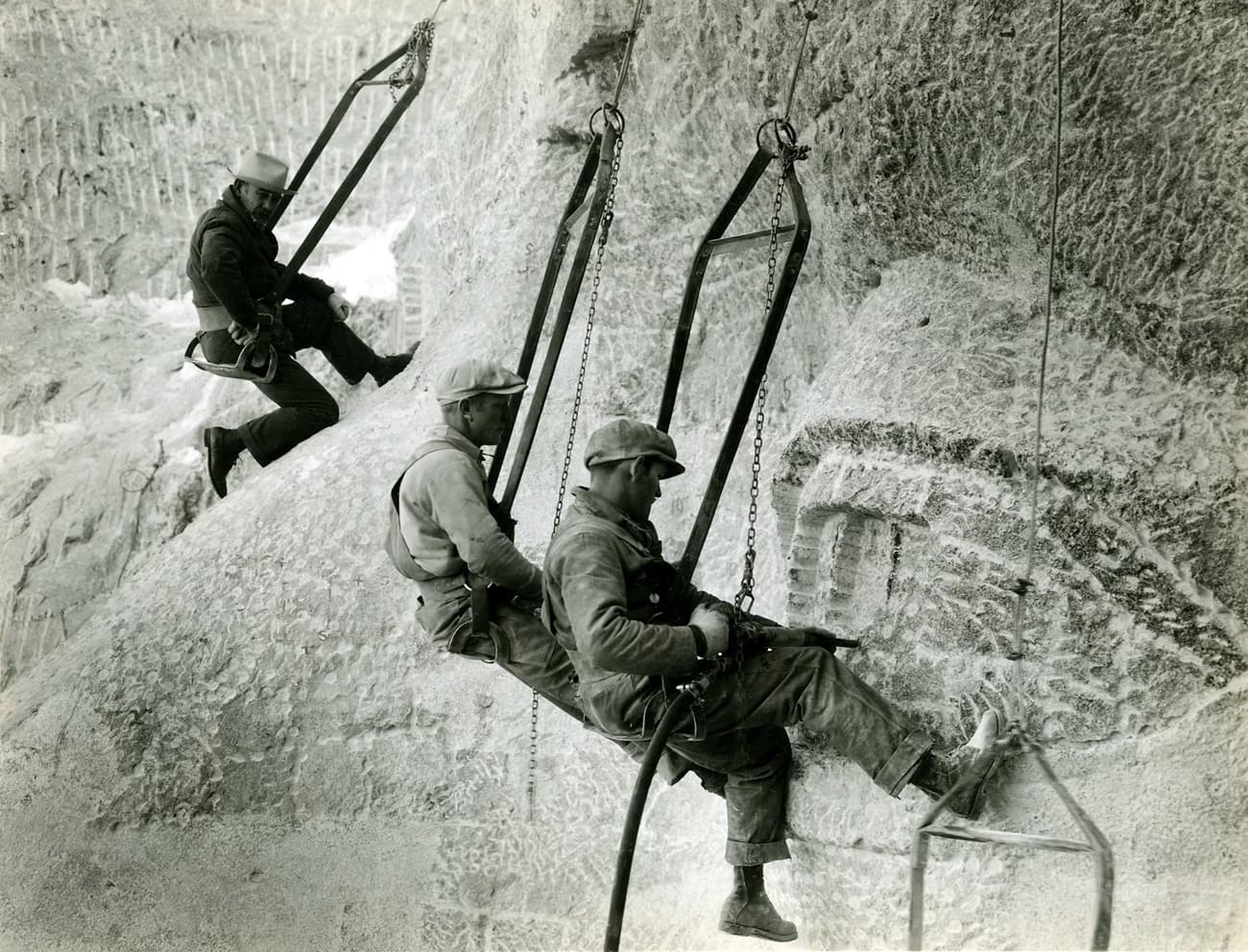
Crews used dynamite to remove much of the rock, followed by pneumatic drilling and careful finishing. Workers descended on cables in suspended seats to reach the carving surface.
Four Presidents in Granite
Borglum selected the four presidents to represent major chapters in American history. Their faces emerged gradually as construction continued through changing seasons and funding difficulties.
Work Ends in 1941
Gutzon Borglum died in March 1941, and his son Lincoln supervised the remaining work. The project was declared complete on October 31, 1941, although the original design had envisioned larger figures extending below the heads.
A Contested Landscape
The monument stands in the Black Hills, a landscape sacred to the Lakota. Its history is inseparable from the United States' seizure of these lands following the discovery of gold, despite treaty protections.
An Enduring Landmark
Mount Rushmore became one of America's most recognizable monuments. Its history combines extraordinary sculptural engineering with continuing questions about national memory and Indigenous land rights.
From blasting to finishing
The National Park Service estimates that dynamite did about 90 percent of the rock removal. When workers approached the intended surface, closely spaced drill holes weakened the remaining granite, a method called honeycombing. Hand finishing followed. The faces were produced by a sequence of industrial removal and precise shaping, rather than by chiseling the entire mountain from the beginning.
Reading the monument as a choice
The presidents and the story they represent were selected by the monument’s creators. That story does not exhaust the history of the Black Hills or erase Lakota claims to the landscape. Engineering history and the history of the land can both be part of understanding the same place.
Timeline
1927-10-04 — Actual carving begins on Mount Rushmore.
1941-03-06 — Sculptor Gutzon Borglum dies; his son Lincoln continues supervising the project.
1941-10-31 — Work on the monument ends, and the project is declared complete.
Location
Black Hills, South Dakota, United States
Sources
Found an error? Send a correction. Read our editorial standards.