
Market Street Before and After the 1906 Earthquake
In April 1906, the Miles Brothers filmed a moving view down Market Street toward San Francisco's Ferry Building. The camera looked ahead from a streetcar as other vehicles and pedestrians used the same corridor.
Published · Updated · 3 min read
A Camera Riding Toward the Ferry
In April 1906, the Miles Brothers filmed a moving view down Market Street toward San Francisco's Ferry Building. The camera looked ahead from a streetcar as other vehicles and pedestrians used the same corridor. The view is valuable because it records ordinary movement, including the ways people crossed tracks and negotiated space with horses, automobiles and streetcars. The earthquake of April 18 gives the film its historical frame, but the people in it were going about their business. They were not performing a farewell to a city they knew would soon change.
Dating the Street Scene
Researchers have used features visible on the film, as well as surviving documentary clues, to place the recording close to the earthquake. This dating matters to the comparison. A copy labeled simply San Francisco, 1906, could easily be mistaken for a reconstruction or for footage from another season. The view toward the Ferry Building provides a fixed point, while the mix of traffic tells viewers about the corridor's changing use. The film works both as evidence of what stood there and as a record of how a busy commercial street functioned.
The Street After April 18
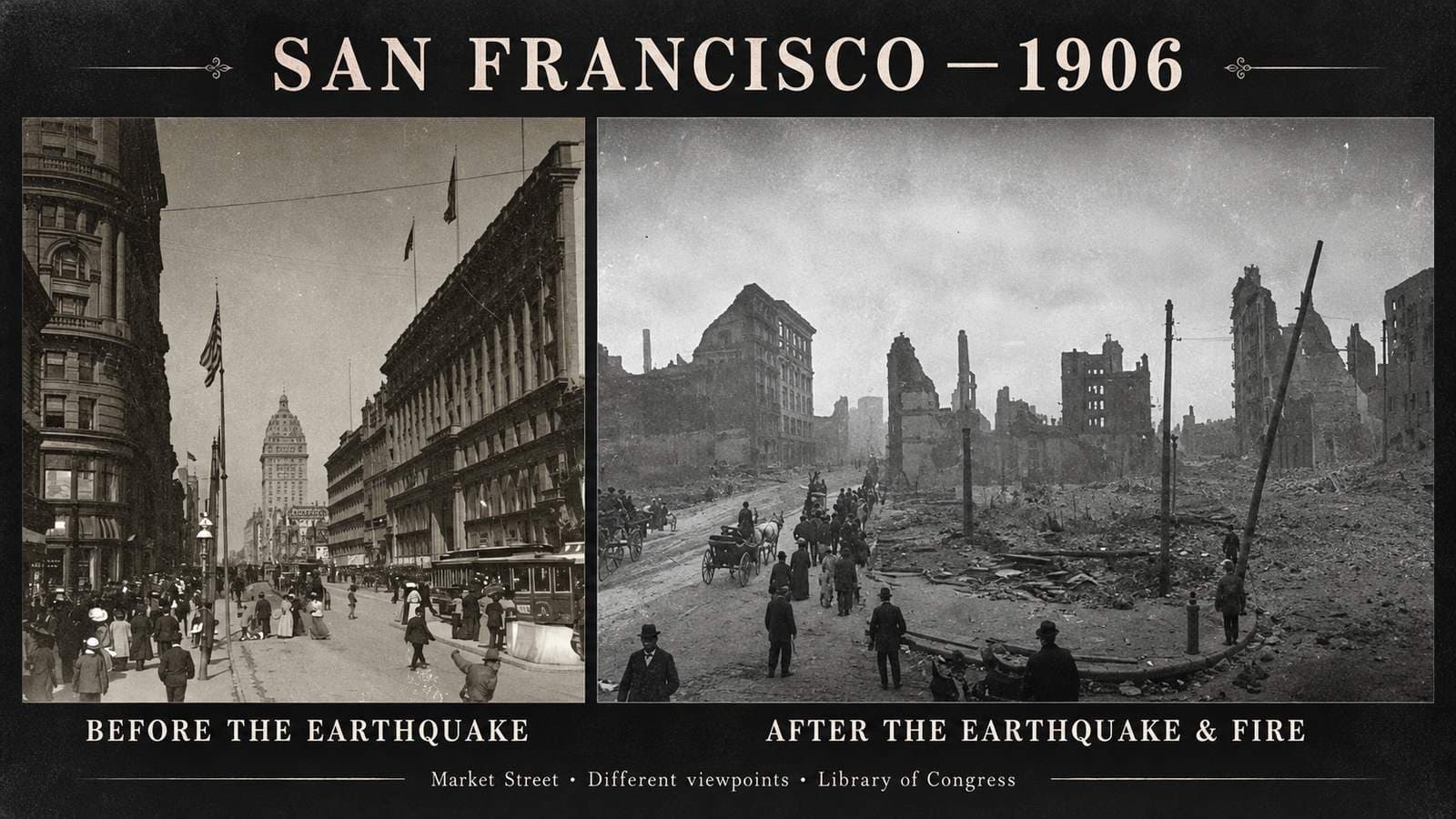
The earthquake shook the city early in the morning. Fires then spread through extensive parts of San Francisco, burning for days and leaving large areas in ruins. Breaks in the water system impeded firefighting. The destruction visible in photographs cannot always be assigned to shaking alone: fire, firefighting measures and the later clearance of unsafe structures could all change what remained on a block. Market Street became a route through a devastated commercial center, and a camera pointed toward the waterfront could register a familiar alignment lined by unfamiliar ruins.
An Anchor at the Waterfront
The Ferry Building remained a recognizable landmark. That continuity makes it useful for comparing views whose nearest buildings and traffic have changed beyond recognition. The viewer can first establish direction, then examine where the rails run, where cross streets open and where individual structures stood. The surviving landmark also reminds us that an earthquake does not distribute damage evenly across a city. Construction, ground conditions and the route of fire produced different outcomes even among places relatively close to one another.
Making a Fair Before and After Pair
A good pairing uses clearly dated archival images and explains differences in camera position. It should identify a still from the pre-earthquake film as a film frame, and a later view as an image made after the disaster, with the date given when it is known. Colorization or a recreated image requires its own label. The street's story lies in what a viewer can compare for themselves: movement becomes obstruction, continuous facades become gaps, and a familiar waterfront landmark allows the two very different views to be understood as parts of the same city.
Sources
Found an error? Send a correction. Read our editorial standards.