Rutgers and Princeton Play the First Intercollegiate Football Game
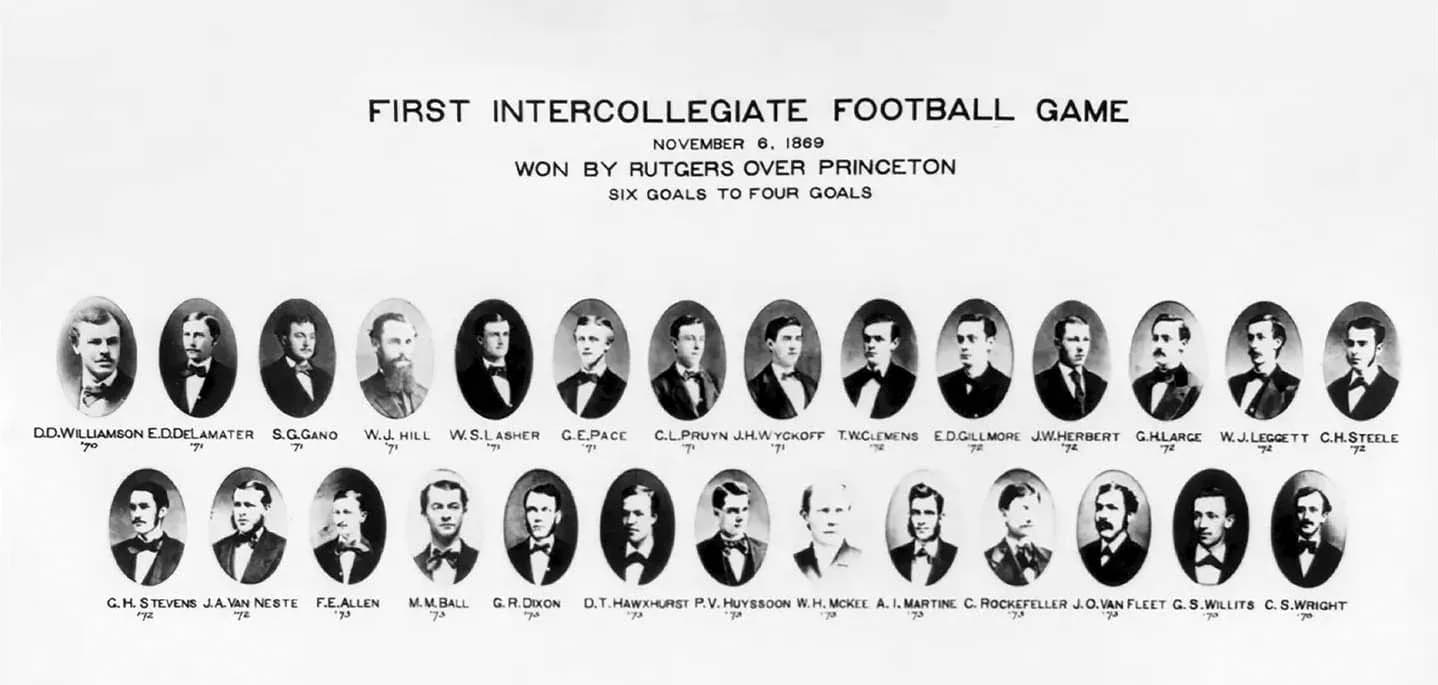
On November 6, 1869, students representing Rutgers and the College of New Jersey, now Princeton University, played a football match in New Brunswick. Rutgers won six goals to four.
Published · Updated · 3 min read
A Saturday in New Brunswick
On November 6, 1869, students representing Rutgers and the College of New Jersey, now Princeton University, played a football match in New Brunswick. Rutgers won six goals to four. The game is conventionally commemorated as the first intercollegiate football game in the United States, but a modern viewer would have recognized more features of association football than of an autumn game in a college stadium today. The players had to agree on a way to compete before there was a national organization to tell them what the word football meant.
How Twenty Five Players Made a Team
Each side fielded twenty five players. The object was to send the ball through the opposing goal, and players could kick or bat it under the rules used at Rutgers. They could not simply pick it up and run downfield. There were no scrimmage formations or familiar sequences of downs, and the scoring record refers to goals rather than touchdowns. With a much larger number of players on the field, congestion around the ball was part of the contest. A pass rush or a quarterback's throw would be anachronisms in a recreation of the match.
A Home Field Meant Home Rules
Early intercollegiate games depended on negotiations between students from different colleges. Clubs did not necessarily share the same rules, and the hosts could have an advantage simply because they understood the version to be played. Rutgers and Princeton met again a week later at Princeton, which won the return match. The two results do not provide a clean measure of a season in the modern sense. The rematch instead reveals how a rivalry could take shape before the institutions involved had even settled on a uniform game.
The Rules Kept Moving
Later contests and conventions brought different approaches together. Some colleges favored games closer to rugby, in which carrying the ball had a larger role. Rule changes associated with Walter Camp in subsequent decades helped establish eleven players, the line of scrimmage and the system of downs. These were successive inventions and compromises. They were not part of the match in New Brunswick. The nineteenth century origin of American college football is therefore better understood as a family of experiments than as one set of rules copied unchanged from a founding event.
What the Anniversary Celebrates
The enduring claim of the Rutgers game concerns who played and how they represented their colleges. Students put together teams, faced another institution and created a result that both schools could remember. That arrangement became a building block of American college sports even as nearly everything on the playing field changed. The score of six to four links the modern rivalry to its predecessor; the unfamiliar way of earning those goals shows just how far the sport traveled.
Sources
Found an error? Send a correction. Read our editorial standards.