
The 2000 Presidential Election Heads Toward the Florida Recount
On November 7, 2000, Americans voted in a presidential election between George W. Bush and Al Gore. The result in Florida was so close that a recount followed, and the outcome was not settled for more than five weeks.
Published · Updated · 3 min read
Election Night
On November 7, 2000, Texas governor George W. Bush, the Republican nominee, faced Vice President Al Gore, the Democratic nominee. Neither candidate had a clear majority of electoral votes by the night's end, and the outcome depended on Florida, which had 25 electoral votes. The television networks projected Florida for Gore in the evening, withdrew that projection later, projected it for Bush in the early morning hours of November 8, and then withdrew that projection as well. Gore, who had telephoned Bush to concede, called back to withdraw his concession.
The Count and the Recounts
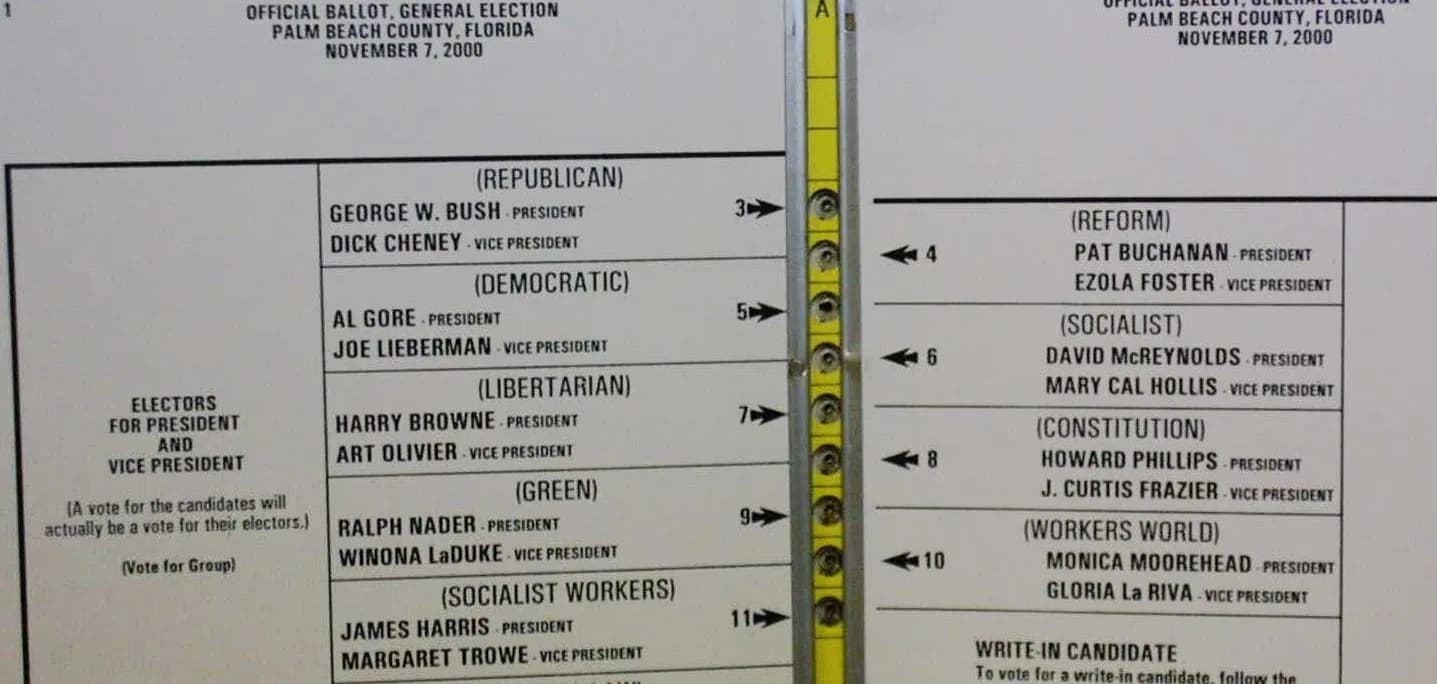
The first count in Florida gave Bush a lead of fewer than two thousand votes out of about six million cast. Florida law requires a machine recount when the margin is under half of one percent, and it cut Bush's lead to a few hundred votes. The Gore campaign asked for manual recounts in four counties, Miami-Dade, Broward, Palm Beach and Volusia. Disputes followed over ballots with partly punched holes, called chads, over the design of the ballot in Palm Beach County, and over deadlines. On November 26 the Florida Secretary of State, Katherine Harris, certified Bush as the winner of the state by 537 votes.
The Courts
Both campaigns went to court. On December 8 the Florida Supreme Court ordered a statewide manual recount of ballots on which machines had registered no vote for president. The United States Supreme Court halted the recount on December 9 and, on December 12, ruled in Bush v. Gore that the recount ordered by Florida's court could not go forward as ordered. Seven justices found problems with the differing standards used to judge ballots under the Equal Protection Clause, and five held that there was not enough time to fix them. Gore conceded on December 13.
The Final Numbers
Bush received 271 electoral votes and Gore 266, with one elector from the District of Columbia not voting. Gore received about 540,000 more votes than Bush nationwide, which is the difference between the popular vote and the Electoral College result in that election. In 2001 a group of news organizations reviewed the uncounted Florida ballots, and reported that the outcome depended on the counting standards that were applied. In 2002 Congress passed the Help America Vote Act, which provided funds for new voting equipment and set requirements for states.
From the Recount to the Inauguration
Electors met in their state capitals on December 18, 2000, and Florida's 25 electoral votes went to Bush. On January 6, 2001, Congress met in joint session to count the electoral votes, and Gore, as Vice President, presided over the count and announced the result. Several members of the House of Representatives objected to Florida's votes, but no senator joined them, as the law requires for an objection to be considered. Bush was sworn in as the 43rd president on January 20, 2001.
Sources
Found an error? Send a correction. Read our editorial standards.