
The Night the Leonids Filled the Sky
In the early hours of November 13, 1833, people across much of eastern North America saw meteors in extraordinary numbers. Reports described bright streaks crossing large parts of the sky, many appearing in quick succession.
Published · Updated · 3 min read
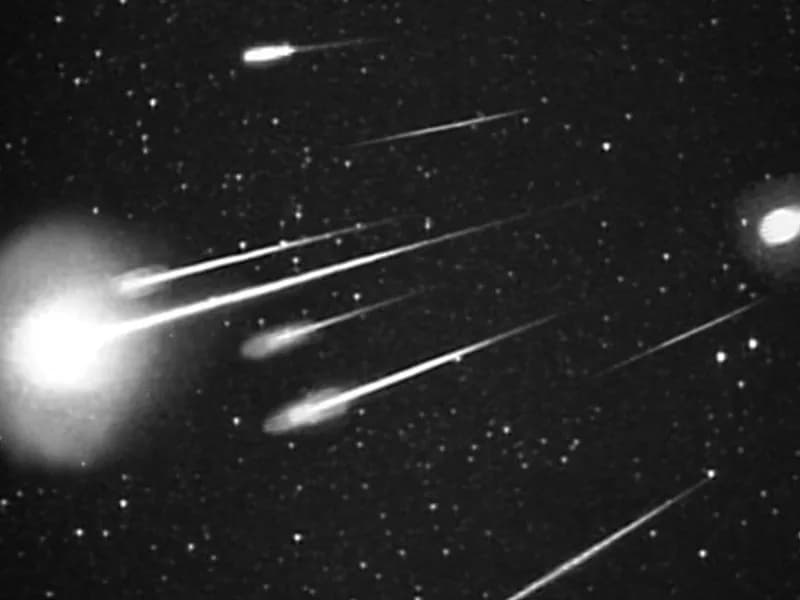
Before Daybreak in North America
In the early hours of November 13, 1833, people across much of eastern North America saw meteors in extraordinary numbers. Reports described bright streaks crossing large parts of the sky, many appearing in quick succession. The event was a meteor storm, a brief encounter with unusually dense material in a recurring meteor stream. Estimates of the rate differ because witnesses were watching under different conditions, and most were never equipped to count an event of this scale. The agreement across widely separated reports is stronger evidence than any single spectacular number.
The Point the Streaks Seemed to Leave
An observer could trace the meteor paths backward toward Leo. The fact that the meteors appeared to diverge from a common point was a clue about the direction in which the particles approached Earth. A long straight road offers a useful comparison: its edges appear to meet in the distance even though they run parallel. In much the same way, particles traveling along nearly parallel paths can produce tracks that seem to radiate across the sky. The position of that radiant among the stars helped investigators separate the event from ordinary atmospheric weather.
Turning Sightings Into Evidence
Denison Olmsted of Yale collected accounts and used them to study the storm. Reports from different locations could help establish how broadly it was seen and whether the radiant behaved like a fixed direction in space. This was an opportunity to ask questions of the same event at many locations instead of trying to explain an isolated flash. Newspaper notices and letters mattered because they preserved observations made before anyone had agreed on what the event was. Even imperfect records could yield a pattern once they were assembled and compared.
The Comet in the Explanation
Later work connected the Leonids with comet 55P/Tempel–Tuttle. A comet sheds dust and small particles as it travels; the material can remain distributed along or near its path. Earth crosses that path each year, but the density of particles it encounters varies. When the planet meets a dense trail, the result can be a storm rather than a modest annual shower. The light is produced as particles rush into the atmosphere. The stars of Leo supply the background against which the radiant is seen; they are vastly farther away than the glowing trails.
Why the Reports Still Matter
The 1833 event is remembered through prints, personal testimony and the investigations those accounts prompted. A dramatic engraving can convey the impression of a sky in motion, while the observations behind it serve a different purpose. They let later readers reconstruct the shape and timing of an event that could not be scheduled in a laboratory. The storm became important to meteor science because people recorded what they saw, where they were and which way the trails seemed to run.
Sources
Found an error? Send a correction. Read our editorial standards.