
Apollo 7 Broadcasts Live Television From Earth Orbit
On October 14, 1968, Apollo 7 transmitted its first live television program from orbit. Wally Schirra, Donn Eisele and Walter Cunningham were aboard the spacecraft, which had launched three days earlier.
Published · Updated · 3 min read
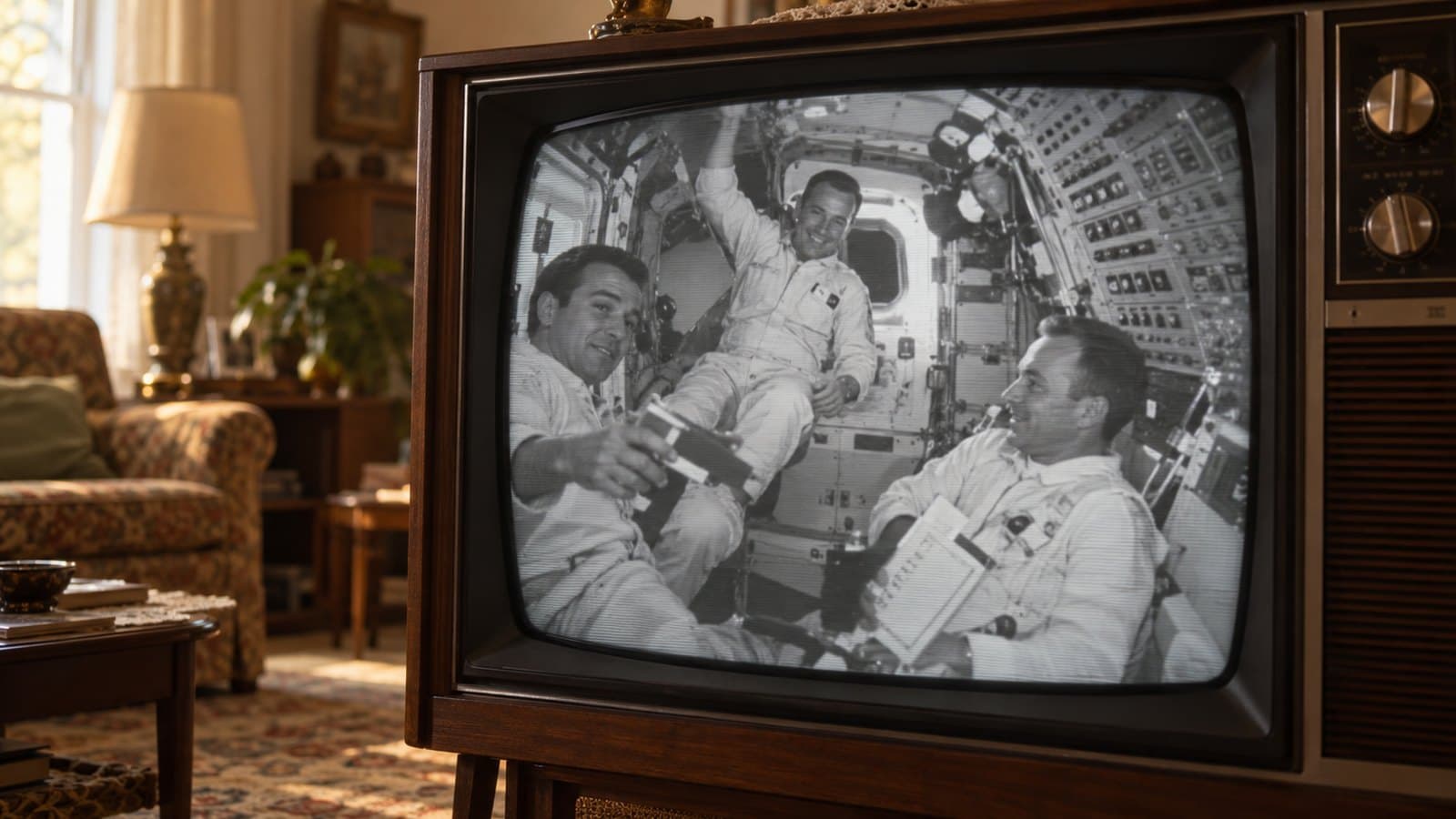
The Cabin Appears on Television
On October 14, 1968, Apollo 7 transmitted its first live television program from orbit. Wally Schirra, Donn Eisele and Walter Cunningham were aboard the spacecraft, which had launched three days earlier. NASA identifies the transmission as the first live television broadcast from a crewed American spacecraft. The qualification matters because space pictures and international television relays already existed. The new thing for the American audience was a live view of astronauts speaking and working in the cabin of their own spacecraft while the mission was in progress.
A Test Flight With a Camera
Apollo 7 was the first crewed flight of the Apollo program. It stayed in Earth orbit, where the astronauts could test the command and service modules and their procedures before later crews ventured farther away. Engine burns, navigation, communication and cabin systems were all more central to the flight than a television appearance. The camera introduced another task into a busy schedule and required suitable communications with the ground. Setting aside time for a transmission meant negotiating what work could wait and what the audience could be shown safely.
What the Picture Could Show
The transmitted picture was black and white and far less detailed than modern video. Its value came from immediacy. The astronauts could address viewers, display signs and turn the camera toward the confined space where they lived. Audiences could observe aspects of the cabin that were hard to communicate through still diagrams or descriptions from mission control. The experience also revealed limits: a view depended on what a person could point the camera at, how the signal reached Earth and which portions of the flight were available for transmission.
Seven Broadcasts and Nearly Eleven Days
Apollo 7 made seven television transmissions during its flight. The astronauts returned on October 22 after almost eleven days. The mission's length gave engineers evidence about how the spacecraft and its crew would function over a period comparable to a longer Apollo journey. The broadcasts offered the public a different record of that endurance, made up of short encounters within the mission. Watching a few minutes of the cabin did not tell viewers everything about its performance, but it let them see the people carrying out the work as it happened.
A Rehearsal for a Wider Audience
Later Apollo missions would make television central to the public experience of lunar exploration. Apollo 7 did something more modest and useful first. It showed that a crew in a working spacecraft could send live images to the ground without making television the mission's main purpose. A historically accurate portrayal keeps the spacecraft near Earth and the television picture limited by its period technology. The October broadcast mattered because the transmission crossed a gap that an ordinary press conference could not: the audience saw the crew in the place where it was actually working.
Sources
Found an error? Send a correction. Read our editorial standards.