
Chang'e 1 Enters Lunar Orbit, China's First Lunar Probe
On November 5, 2007, China's Chang'e 1 spacecraft entered orbit around the Moon, about twelve days after its launch on October 24. It was the first spacecraft of China's lunar exploration program.
Published · Updated · 3 min read
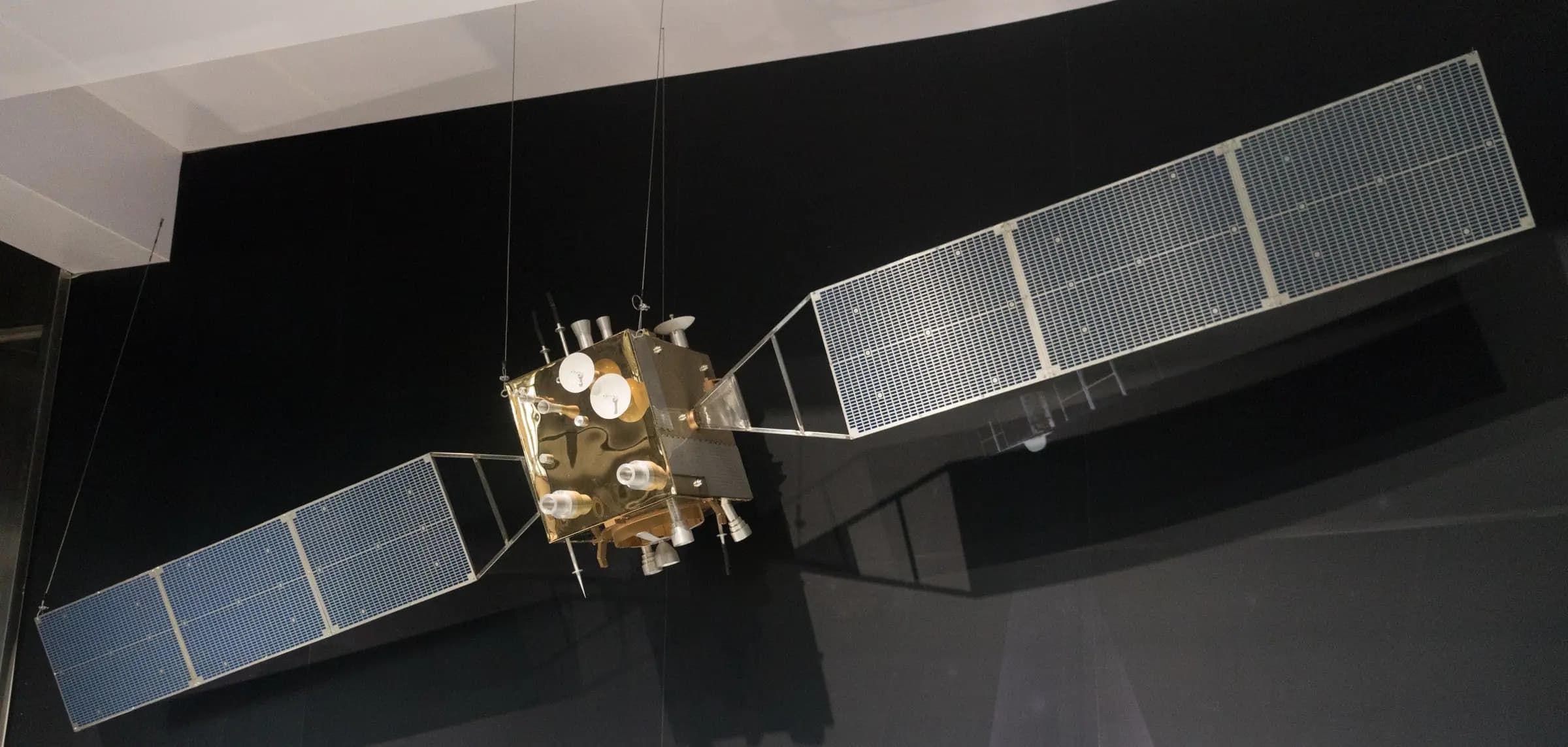
The First Step of a Lunar Program
Chang'e 1 was the first mission of China's lunar exploration program, which Chinese officials describe as a sequence of three stages: orbiting the Moon, landing on it, and returning samples to Earth. The spacecraft is named after Chang'e, a goddess of the Moon in Chinese mythology. It was built by the China Academy of Space Technology, and the program is run by the China National Space Administration.
Launch and Transfer
A Long March 3A rocket launched Chang'e 1 from the Xichang Satellite Launch Center in Sichuan province on October 24, 2007. The spacecraft first circled the Earth in elongated orbits, raising its high point with several engine burns, and then fired for the trip to the Moon. According to NASA's mission summary, it left its transfer orbit at the end of October. On November 5 the spacecraft's engine slowed it down so that the Moon's gravity could capture it, and controllers at the Beijing Aerospace Control Center confirmed that it had entered lunar orbit.
Instruments and Orbit
After a series of adjustments Chang'e 1 settled into a circular orbit that passed over the Moon's poles at an altitude of about 200 kilometers. It carried a stereo camera, a laser altimeter for measuring surface height, an imaging spectrometer, a gamma-ray and X-ray spectrometer, a microwave radiometer, and instruments for measuring particles in space near the Moon. The first image from the camera was released in late November 2007. Chinese scientists later assembled the data into a full map of the lunar surface and a three-dimensional model of its terrain.
End of the Mission
The mission was planned to last one year, and it was extended while the spacecraft was still working. On March 1, 2009, controllers commanded Chang'e 1 to leave orbit and descend to the surface, where it struck the Moon in the Mare Fecunditatis region. Later missions continued the program. Chang'e 3 landed with the Yutu rover in December 2013, and Chang'e 5 returned lunar samples to Earth in December 2020.
Later Missions in the Program
Chang'e 2 was launched on October 1, 2010, and tested techniques for later landings from a lower lunar orbit. Chang'e 3 landed in December 2013. Chang'e 4 landed on January 3, 2019, in the Von Karman crater on the far side of the Moon, which is the side that always faces away from Earth, and it relied on a relay satellite to communicate with controllers. Chang'e 5 brought samples back to Earth in December 2020, and Chang'e 6 returned samples from the far side in June 2024.
Sources
Found an error? Send a correction. Read our editorial standards.