
Mariner 10 Sets Out on a Double Journey to Venus and Mercury
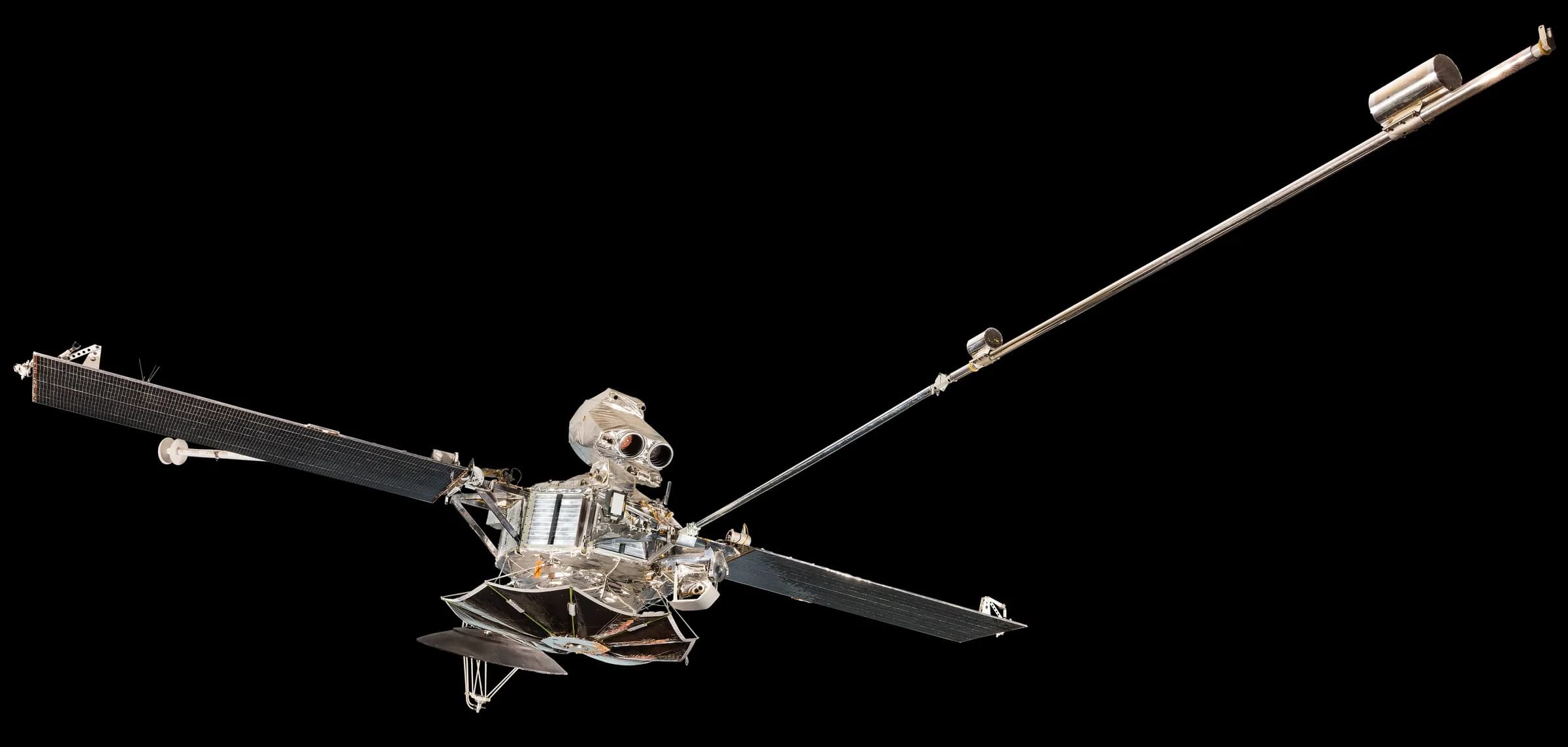
On November 3, 1973, NASA launched Mariner 10, the first spacecraft to use a gravity assist from one planet to reach another. It went on to make the first close observations of Mercury.
Published · Updated · 3 min read
A Difficult Target
Mercury is hard to reach. It orbits deep in the Sun’s gravity well, and a spacecraft sent straight toward it picks up so much speed that it would simply shoot past. Slowing it down would need a large amount of fuel that a rocket of the time could not carry. The solution came from using the gravity of another planet. The Italian scientist Giuseppe Colombo helped show that a spacecraft passing Venus could be bent into an orbit that brought it to Mercury, and that its orbit afterwards could allow repeat visits. NASA’s Jet Propulsion Laboratory built Mariner 10 to try the plan.
Launch and the Venus Flyby
Mariner 10 left Cape Canaveral on November 3, 1973 on an Atlas-Centaur rocket. On February 5, 1974 it flew past Venus and used the planet’s gravity to reshape its path toward Mercury, the first time any spacecraft had used the technique. The pass also returned a bonus: ultraviolet images of Venus’s thick clouds, which revealed bands and swirls that hinted at fast winds high in the atmosphere. The Venus images were among the first to show the planet’s cloud motions in detail.
Three Looks at Mercury
On March 29, 1974 Mariner 10 made the first close approach to Mercury by any spacecraft, passing within a few hundred miles of the surface. It returned to the planet twice more, on September 21, 1974 and March 16, 1975. Together the three flybys produced thousands of images covering nearly half of the surface. They showed a heavily cratered world that looked much like the Moon. Instruments also detected a magnetic field, a surprise for such a small planet, which suggested that Mercury has a large iron core, still partly molten.
The End and the Aftermath
In March 1975 Mariner 10 ran out of the gas that kept it pointing correctly, and NASA stopped its transmissions. The spacecraft probably still orbits the Sun. Its observations shaped the next missions. The half of Mercury it could not see remained unseen until the MESSENGER spacecraft mapped the whole planet after 2011, and the European–Japanese BepiColombo mission, launched in 2018, has built on those results. The gravity assist Mariner 10 proved is now a standard tool for exploring the solar system.
A Strange Small World
Mercury is the smallest planet and the closest to the Sun, and its surface swings between extremes of roughly 430 degrees Celsius in the day and minus 180 at night. Mariner 10’s pictures showed long cliffs called scarps, which suggested that the planet’s crust had shrunk as its interior cooled, and they revealed part of a huge impact crater, the Caloris Basin. The magnetic field was a surprise, because scientists had expected such a small planet to have cooled completely. Each of these discoveries posed questions that later missions are still working to answer.
Sources
Found an error? Send a correction. Read our editorial standards.