
Mars Observer Launches Toward the Red Planet
On September 25, 1992, NASA launched Mars Observer from Cape Canaveral aboard a Titan III. The spacecraft was intended to study Mars from orbit, building a long record of surface conditions, atmosphere and other planetary properties.
Published · Updated · 3 min read
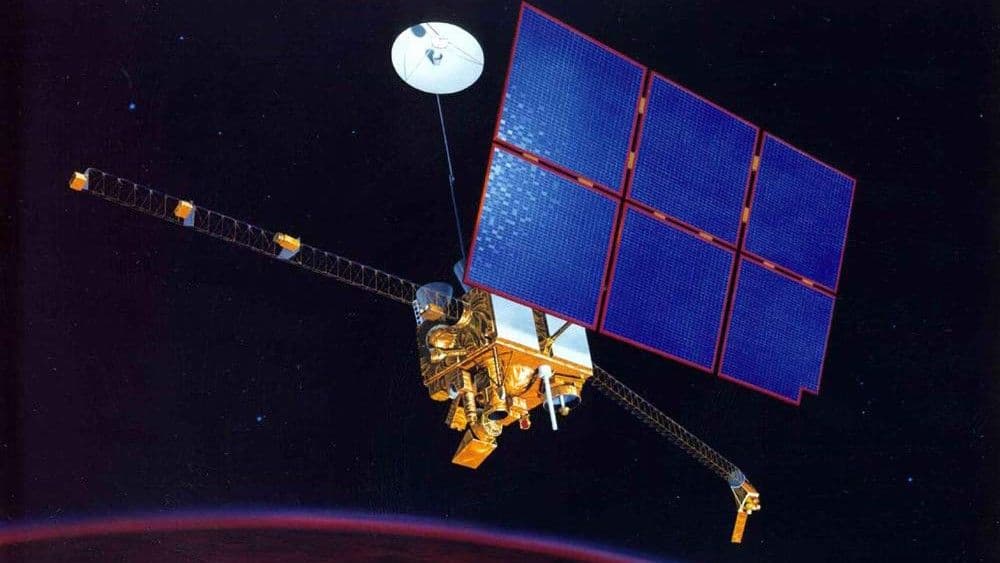
A Map Mission Leaves Earth
On September 25, 1992, NASA launched Mars Observer from Cape Canaveral aboard a Titan III. The spacecraft was intended to study Mars from orbit, building a long record of surface conditions, atmosphere and other planetary properties. Rather than concentrate on a single landing site, it would pass over many areas from a polar orbit. The resulting measurements could be compared across regions and seasons. The launch put those instruments on their way after a long gap in successful American missions to Mars, but success depended on many later steps the rocket could not perform for them.
The Measurements the Team Wanted
The mission combined instruments for imaging, mapping elevation, examining atmospheric conditions and investigating the surface and its composition. A repeated orbit would allow scientists to make measurements in a consistent geographic framework. A photograph might show a distinctive landform, while an elevation profile could establish its height or depth. Information about dust, temperature and seasonal changes would help explain how conditions differed when images were taken. The larger value lay in being able to put these observations together, so that each was more informative than it would have been in isolation.
The Flight Before Mars
For nearly eleven months, the spacecraft traveled toward Mars. Mission controllers could communicate with it during cruise and prepare it for arrival. Orbital insertion would require the spacecraft to change speed enough to be captured by the planet's gravity. Losing contact close to that maneuver was especially serious because there would be little opportunity to diagnose a fault before the geometry of the encounter changed. A successful launch and a long period of normal communication were evidence that some parts of the flight had worked, but they did not guarantee that the next set of operations would succeed.
Contact Is Lost
Controllers lost contact on August 21, 1993, shortly before planned orbit insertion. Attempts to restore communication failed. An investigation considered a failure related to the propulsion system among the most plausible explanations, but without definitive telemetry the exact sequence could not be proved. Mars Observer produced no planned global mapping record. The uncertainty is an important part of the failure, since investigators could examine design details and the timing of events while lacking direct observation of what the spacecraft had done in its final moments.
The Program Outlasts the Spacecraft
Later missions carried replacements or successors to several of Mars Observer's instruments. Mars Global Surveyor eventually returned major portions of the kind of planetary record that the earlier mission had intended to produce. That continuity did not reverse the loss, but it preserved scientific questions and engineering work that could be assigned to a different spacecraft. The September 1992 launch belongs to the history of Mars exploration for that reason as well as for its failure. It shows how a research program can survive the loss of the vehicle first chosen to carry it out.
Sources
Found an error? Send a correction. Read our editorial standards.