
NASA's DART Spacecraft Strikes Dimorphos
On September 26, 2022, NASA's Double Asteroid Redirection Test spacecraft struck Dimorphos, a small moon orbiting the larger asteroid Didymos. Neither object threatened Earth.
Published · Updated · 3 min read
A Planned Collision
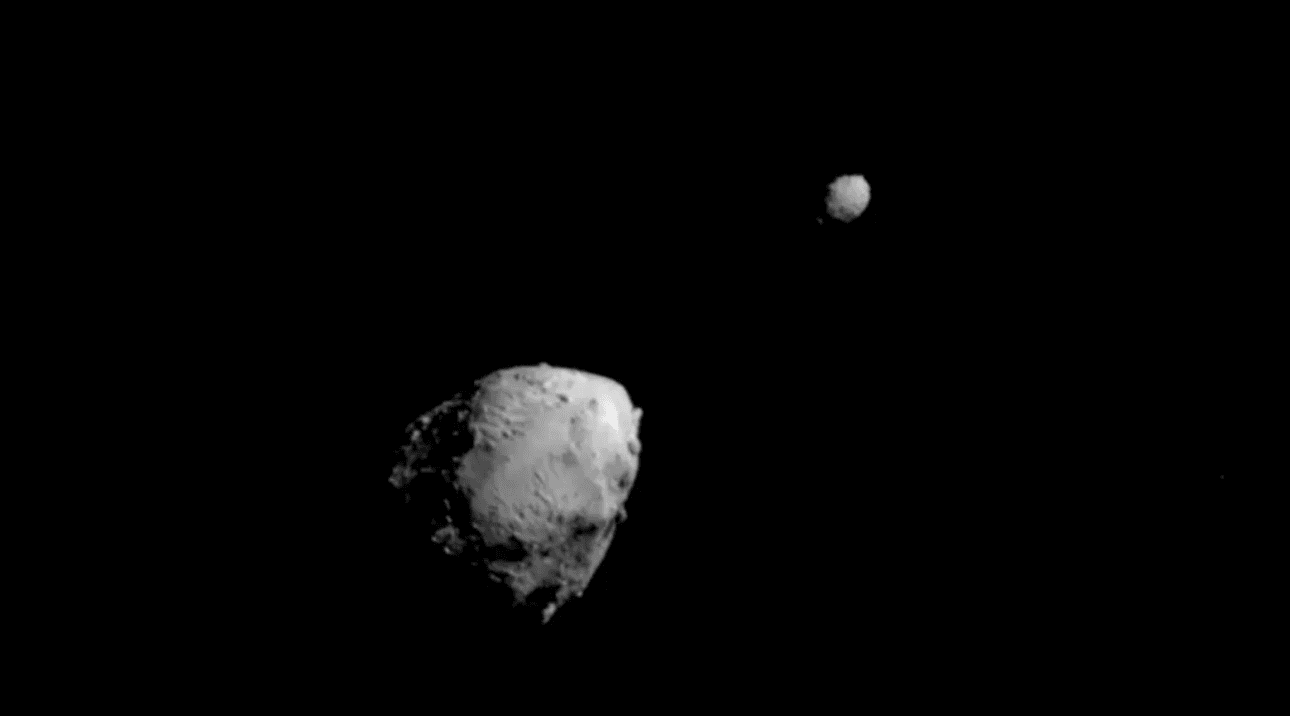
On September 26, 2022, NASA's Double Asteroid Redirection Test spacecraft struck Dimorphos, a small moon orbiting the larger asteroid Didymos. Neither object threatened Earth. The system was chosen because astronomers could observe it and measure a change in the time Dimorphos took to travel around Didymos. The spacecraft was intended to hit its target rather than survive. Its final images became more detailed as it approached, then stopped at impact. That interruption was part of the expected outcome, while the proof of the experiment had to come from observations made elsewhere.
Choosing an Orbit That Could Be Timed
A small impact produces a small change in the motion of an asteroid. Measuring that directly along the asteroid's path around the Sun would be difficult over a short period. In a binary system, the smaller object's orbit offers another clock. Telescopes can track changes in the combined brightness as one body passes in front of the other or into shadow. By comparing those patterns before and after the impact, observers could determine whether the smaller body was completing its circuit faster. The system supplied a way to turn a subtle change into repeated measurements.
Guiding the Spacecraft to a Small Target
Dimorphos was too small to be an easy target during much of the approach. The spacecraft used its camera and autonomous guidance to distinguish it from Didymos and correct its path in the final phase. Ground controllers could not steer every last movement in real time. The images transmitted on approach gave viewers a record of the target's rocky surface, but their operational purpose was to help the vehicle decide where to go. A separate Italian spacecraft, LICIACube, observed the aftermath from nearby and imaged material thrown out by the collision.
A Change Larger Than Contact Alone
NASA initially reported that Dimorphos's orbital period had shortened by about thirty two minutes. Later analysis refined the measurement. Material escaping the impact carried momentum away, contributing to the push on the target. The magnitude of such an effect depends on the body and the impact conditions. A porous rubble pile can respond differently from a more coherent object. DART established that a kinetic impact could produce a measurable orbital change in this test, while leaving researchers with more to learn about how to predict the response of a different asteroid.
What Planetary Defense Can Take From It
A deflection mission would need warning time, a reliable orbit for the threatening object and a way to verify that a change was large enough. DART tested part of that sequence on a body that posed no danger. It also connected three kinds of work that could have failed separately: hitting a moving target, documenting the impact and timing the changed orbit. The experiment is significant because all three produced evidence. Its success is measured by the motion of Dimorphos afterward, rather than by the spectacle of the collision.
Sources
Found an error? Send a correction. Read our editorial standards.