
The First Resident Crew Moves Into the International Space Station
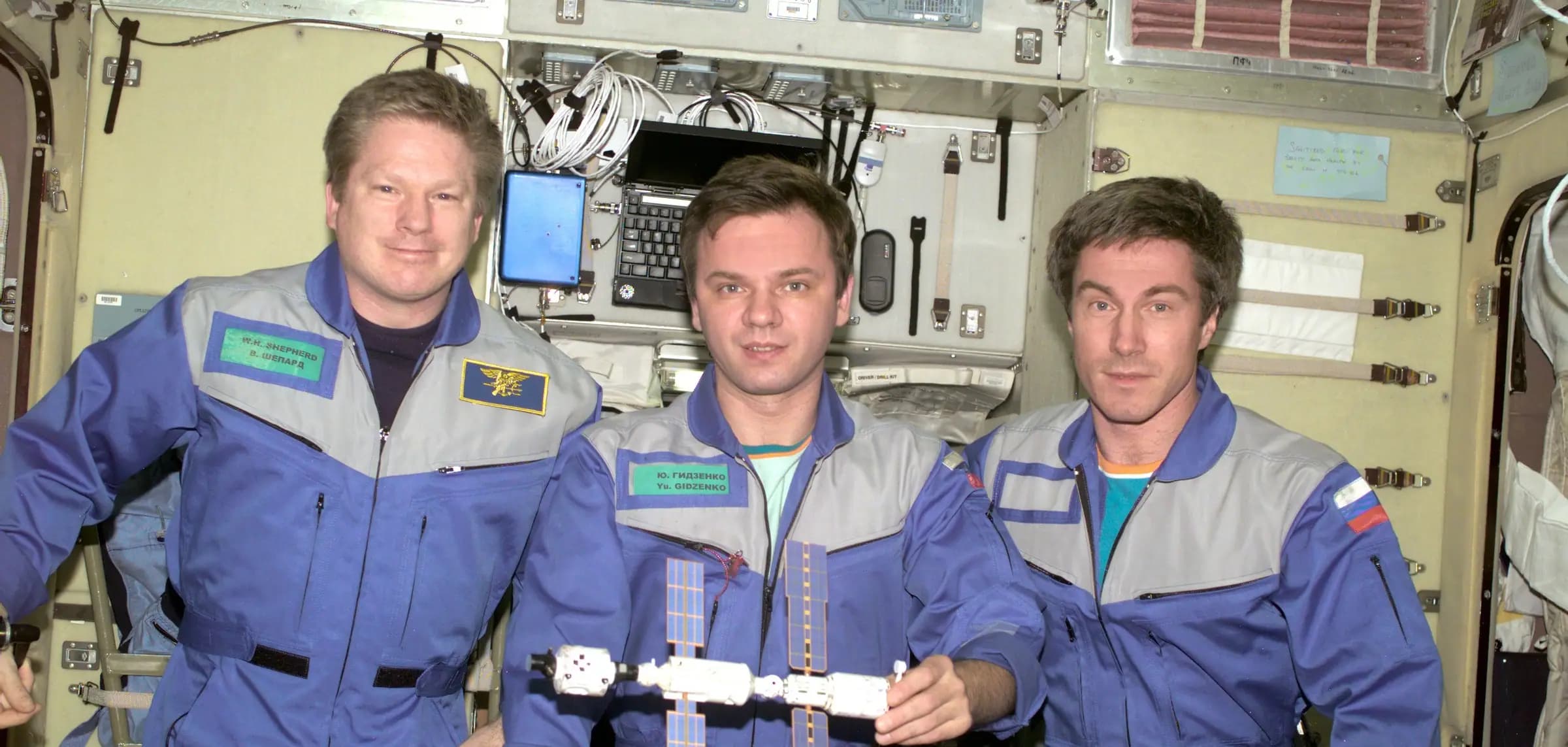
On November 2, 2000, Expedition 1 commander Bill Shepherd and cosmonauts Yuri Gidzenko and Sergei Krikalev docked at the International Space Station. People have lived aboard continuously ever since.
Published · Updated · 3 min read
A Station Ready for Its First Residents
By the autumn of 2000 the International Space Station was still a very small outpost. Its first two pieces, the Russian-built Zarya and the American-built Unity, had been joined in orbit in 1998. The Russian Zvezda service module followed in July 2000 and supplied living quarters, life support, and the computers that controlled the early station. With those three pieces in place, the partners could begin permanent habitation. The first crew was chosen to test whether people could live and work in the unfinished station, turn its systems on, and prepare it for the modules to come.
Three Men and a Soyuz
Expedition 1 combined experience from both of the main partners. Bill Shepherd, a former Navy SEAL and a NASA astronaut, served as commander. Yuri Gidzenko, a Russian Air Force officer, commanded the Soyuz spacecraft that carried them. Sergei Krikalev, a veteran who had spent long periods on the Russian space station Mir, served as flight engineer. Their Soyuz capsule left the Baikonur Cosmodrome in Kazakhstan on October 31, 2000. Two days later, on November 2, it docked with the aft end of the Zvezda module, and the crew entered a station that was cold, quiet, and still being switched on.
Life in an Unfinished Station
The crew spent about four and a half months aboard. They checked equipment, set up computers and communications, and began a routine of exercise, maintenance, and experiments. They also worked with visiting space shuttle crews that delivered the station’s first large solar arrays in December 2000 and the American Destiny laboratory in February 2001. Their long stay also showed how much of an adjustment it was for hardware and humans alike to live together in orbit. In March 2001 the crew handed the station over to the next expedition and returned to Earth aboard the space shuttle Discovery.
A Presence That Has Never Stopped
Expedition 1 began a chain that has not been broken. Since November 2, 2000 the station has been continuously occupied, with crews from many countries replacing one another. The station has grown into a laboratory the size of a football field, a place where research in biology, medicine, materials, and Earth observation is carried out in microgravity. The first crew did not see that finished station, but their months aboard proved that an international team could keep a spacecraft alive and working, and that proof is what the later expeditions built on.
A Partnership in Orbit
The International Space Station is a joint project of five space agencies: NASA in the United States, Roscosmos in Russia, the European Space Agency, the Japan Aerospace Exploration Agency, and the Canadian Space Agency. Its parts were built in many countries and launched on both American and Russian rockets. Expeditions are numbered in sequence, and each crew inherits the work of the last. The first of them showed that this arrangement could function in practice, with Russians and Americans sharing a small space, a daily schedule, and a set of safety procedures written in two languages.
Sources
Found an error? Send a correction. Read our editorial standards.