Perryville: Why Gaining Ground Did Not Win Kentucky
On October 8, 1862, Confederate attacks forced Union troops backward at Perryville. The Confederate retreat that night nevertheless ended the campaign without securing Kentucky.
Published · Updated · 2 min read
An invasion reached a crossroads
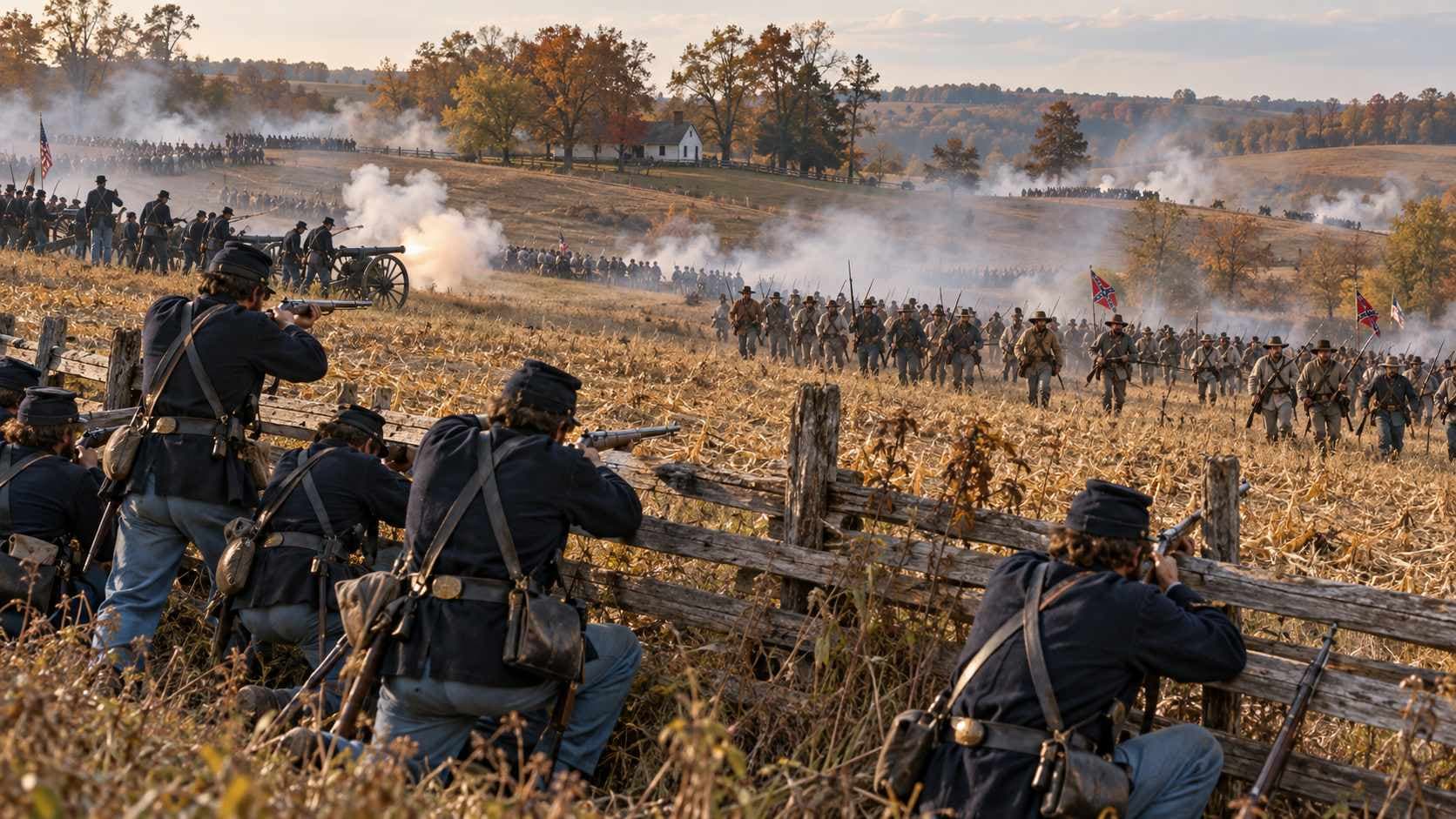
On October 8, 1862, Confederate General Braxton Bragg’s army fought Union forces under General Don Carlos Buell near Perryville, Kentucky. The battle formed part of a Confederate campaign intended to gain control of the state. Roads around the small town brought the opposing forces into contact.
Skirmishing preceded the main battle
Union columns converged on Perryville on October 7. Initial fighting occurred along the Springfield Pike and around Peters Hill. The larger engagement followed on October 8. Accounts mentioning the earlier date are describing the approach and preliminary encounters, rather than moving the main battle to another day.
A mistaken picture of the enemy
The American Battlefield Trust explains that Bragg believed he faced only a portion of Buell’s army, based on information from his cavalry. The main Union force was actually converging nearby. That difference between perceived and actual strength influenced the Confederate decision to fight.
The Union left came under pressure
Fighting resumed near Peters Hill at dawn. After noon, Confederate attacks struck the Union left and forced parts of the line back. Additional Confederate troops joined the action, and some Union units were driven from their positions. Reinforcements helped stabilize the threatened line before the attacks could produce a decisive collapse.
An intersection mattered as much as open ground
Confederate troops did not capture the Dixville Crossroads, an important Union intersection. Roads connected the fighting positions to movement and support. Holding that junction helped limit the consequences of the Confederate advances elsewhere on the battlefield.
The army withdrew during the night
By the end of the day, Bragg recognized the presence of the larger Union army. His force was short of men and supplies, and continued fighting risked a worse outcome. He withdrew overnight. The subsequent retreat carried the Confederate forces out of Kentucky and ended the offensive.
Two different meanings of victory
The American Battlefield Trust describes a Confederate tactical victory followed by failure to achieve the campaign’s objective. Confederate troops gained ground during the battle, but their army did not secure Kentucky. This distinction explains how favorable local fighting can coexist with an unfavorable strategic result.
Sources
Found an error? Send a correction. Read our editorial standards.