Before the Moon Landing: Apollo 7 Takes Flight
On October 11, 1968, Apollo 7 launched with Wally Schirra, Donn Eisele and Walt Cunningham. Their nearly eleven-day Earth-orbit mission tested the spacecraft systems needed for later lunar expeditions.
Published · Updated · 2 min read
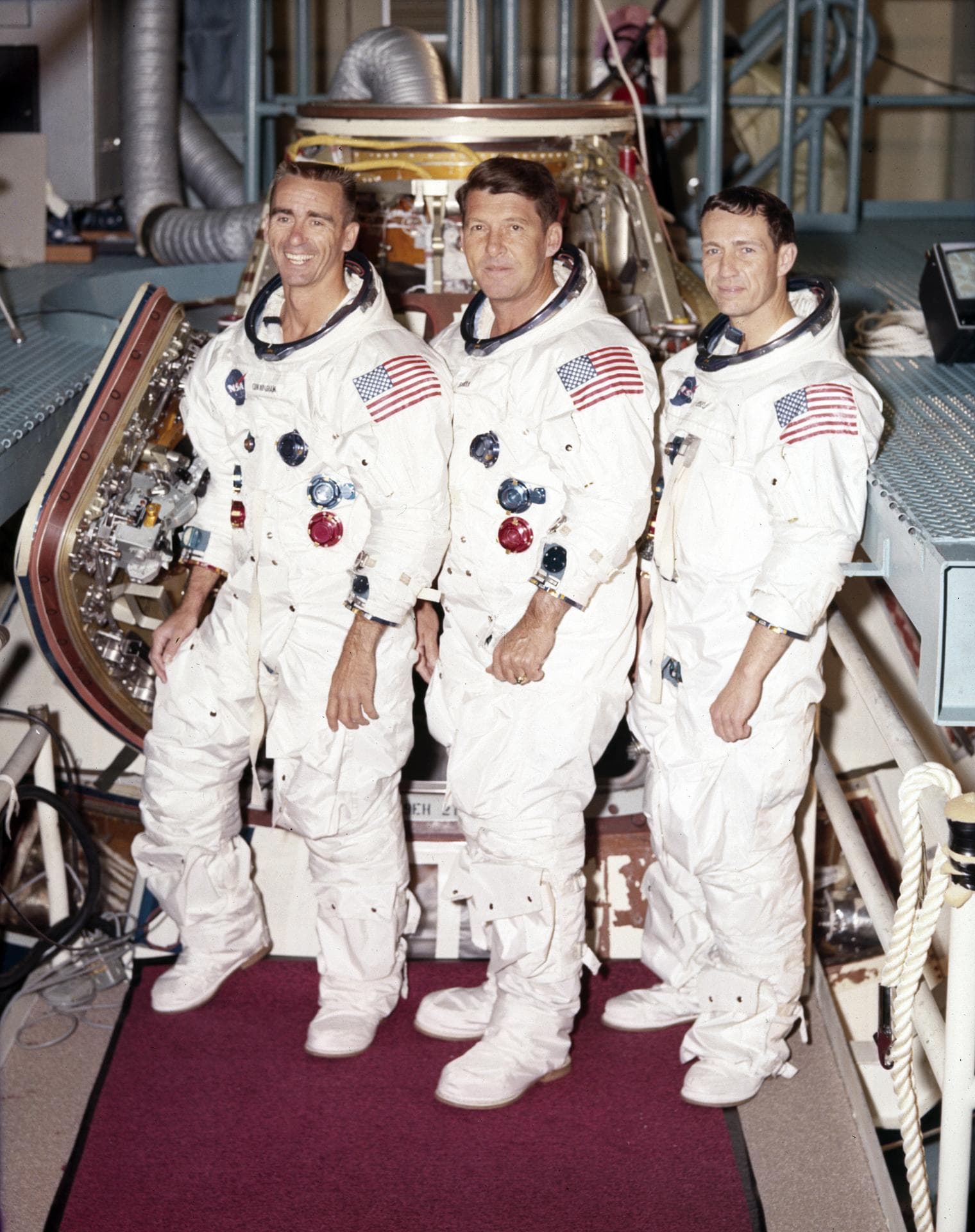
The First Crewed Apollo Flight
On October 11, 1968, Apollo 7 lifted off from Launch Complex 34 at Cape Kennedy, Florida. Commander Walter M. Schirra Jr., command module pilot Donn F. Eisele and astronaut R. Walter Cunningham became the first crew to fly an Apollo mission in space.
Returning After the Apollo 1 Tragedy
The mission followed the January 1967 launch-pad fire that killed Apollo 1 astronauts Gus Grissom, Ed White and Roger Chaffee. The intervening period brought extensive spacecraft redesign and testing. Apollo 7 was a crucial opportunity to evaluate the revised spacecraft with a crew aboard.
A Saturn IB Launch
Apollo 7 flew on a Saturn IB rocket, not the larger Saturn V later associated with lunar missions. It was the first crewed launch of the Saturn IB. The rocket placed the command and service module into Earth orbit, where the astronauts could conduct their planned tests.
Testing the Spacecraft
The crew evaluated the command and service module, including propulsion, spacecraft controls and the systems supporting life aboard. These checks were essential before sending astronauts farther from Earth. Apollo 7’s purpose was to demonstrate reliable operation, rather than attempt a lunar journey.
Practicing Rendezvous
After separating from the spent upper stage, the astronauts performed maneuvers that helped evaluate rendezvous capabilities. Approaching another object in orbit required precise navigation and control. Such operations would become important to the more complex missions that followed.
Television From Orbit
During the mission, the crew conducted the first live television broadcast from an American spacecraft. The transmissions gave viewers a glimpse of life inside the command module. They were part of the orbital mission, rather than an event that occurred during the launch itself.
Almost Eleven Days Around Earth
Apollo 7 remained in flight for approximately ten days and twenty hours, completing 163 Earth orbits. The astronauts returned on October 22, 1968, splashing down in the Atlantic Ocean. The recovery ship was USS Essex.
A Step Toward the Moon
The flight demonstrated the command and service module’s capabilities and helped prepare the Apollo program for subsequent missions. Apollo 7 never traveled to the Moon and carried no lunar module. Its achievement was proving essential systems closer to Earth before the program attempted more distant journeys.
About the Historical Recreation
The accompanying video is an AI-generated historical recreation, not archival footage. It depicts a Saturn IB launch, an illustrative command-module interior and views of Earth. Cuts between launch and orbit compress elapsed time and should not imply that the spacecraft reached orbit within the video’s few seconds.
Sources
Found an error? Send a correction. Read our editorial standards.