NASA’s DART Mission: The Day Humanity Changed an Asteroid’s Orbit
On September 26, 2022, NASA deliberately crashed the DART spacecraft into Dimorphos. The impact tested whether a spacecraft could change an asteroid’s motion.
Published · Updated · 2 min read
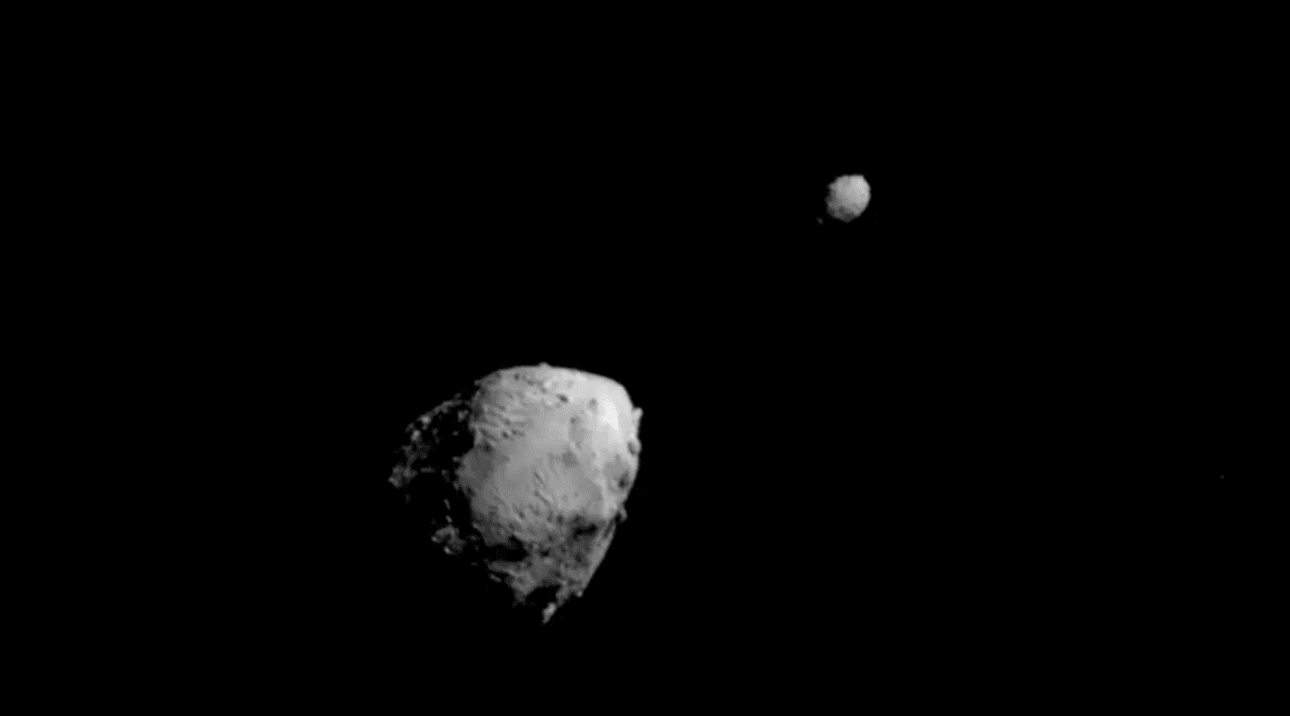
On September 26, 2022, NASA’s DART spacecraft deliberately flew into Dimorphos, a small asteroid orbiting a larger asteroid called Didymos. The collision was the first test of a planetary defense technique known as kinetic impact: striking an asteroid with a spacecraft to change its motion.
Why hit an asteroid?
Dimorphos was not on a collision course with Earth. NASA chose it as a test target because astronomers could measure how long it took to orbit Didymos before and after the impact. The question was whether a small change made deliberately, with enough warning, could become a useful tool for planetary defense.
The spacecraft’s final seconds
As DART closed in, its onboard camera sent images of Dimorphos back to Earth. The asteroid grew larger in each frame. The last complete image was captured about two seconds before the spacecraft struck its surface.
Did the test work?
Before the impact, Dimorphos took about 11 hours and 55 minutes to orbit Didymos. In October 2022, NASA announced an initial measured period of about 11 hours and 23 minutes: roughly 32 minutes shorter. That early result showed that a spacecraft impact can measurably alter an asteroid’s motion; subsequent observations refined the measurements.
Why September 26 matters
DART did not stop an asteroid that was heading for Earth. It tested a method that could help protect Earth if a hazardous asteroid were discovered far enough in advance. On September 26, 2022, that idea moved from planning to a successful experiment in space.
Measuring a change, not preventing an emergency
The first announced measurement put the period change at about 32 minutes, with an uncertainty of roughly two minutes. This was an observation of Dimorphos’s orbit around Didymos. It should not be described as moving an Earth-bound asteroid out of the way: neither member of the pair posed that threat.
Why advance warning matters
A small adjustment to an object’s motion can accumulate into a larger positional difference over time. That is the practical idea behind testing an impact years before a hypothetical collision, rather than waiting for an asteroid to arrive. DART established a measurable response in one target system; it did not demonstrate that the same spacecraft could solve every asteroid hazard.
Sources
Found an error? Send a correction. Read our editorial standards.