Perryville: The Battle That Ended a Confederate Bid for Kentucky
On October 8, 1862, Confederate and Union troops fought outside Perryville, Kentucky. A drought had reduced streams and made water a practical concern for thousands of soldiers and animals.
Published · Updated · 3 min read
An Army Looking for Water
On October 8, 1862, Confederate and Union troops fought outside Perryville, Kentucky. A drought had reduced streams and made water a practical concern for thousands of soldiers and animals. Advance units moved toward the few usable sources near town, where contact could escalate before commanders understood how many men were nearby. Kentucky's political and military position made the campaign larger than the immediate struggle over a creek. Confederate leaders hoped their invasion would gain recruits and influence in a border state that had remained in the Union.
Armies Converging Without a Clear Picture
Confederate general Braxton Bragg and Union general Don Carlos Buell had been maneuvering through Kentucky for weeks. Their armies approached Perryville with incomplete information about the other's strength and location. Bragg committed troops against what he understood to be an exposed part of the Union army. Buell, meanwhile, had a larger force in the vicinity than the Confederates realized, but much of it did not take part in the heaviest fighting. The numbers available on the campaign map therefore tell a different story from the numbers actually brought into action on a particular hillside.
The Confederate Attack
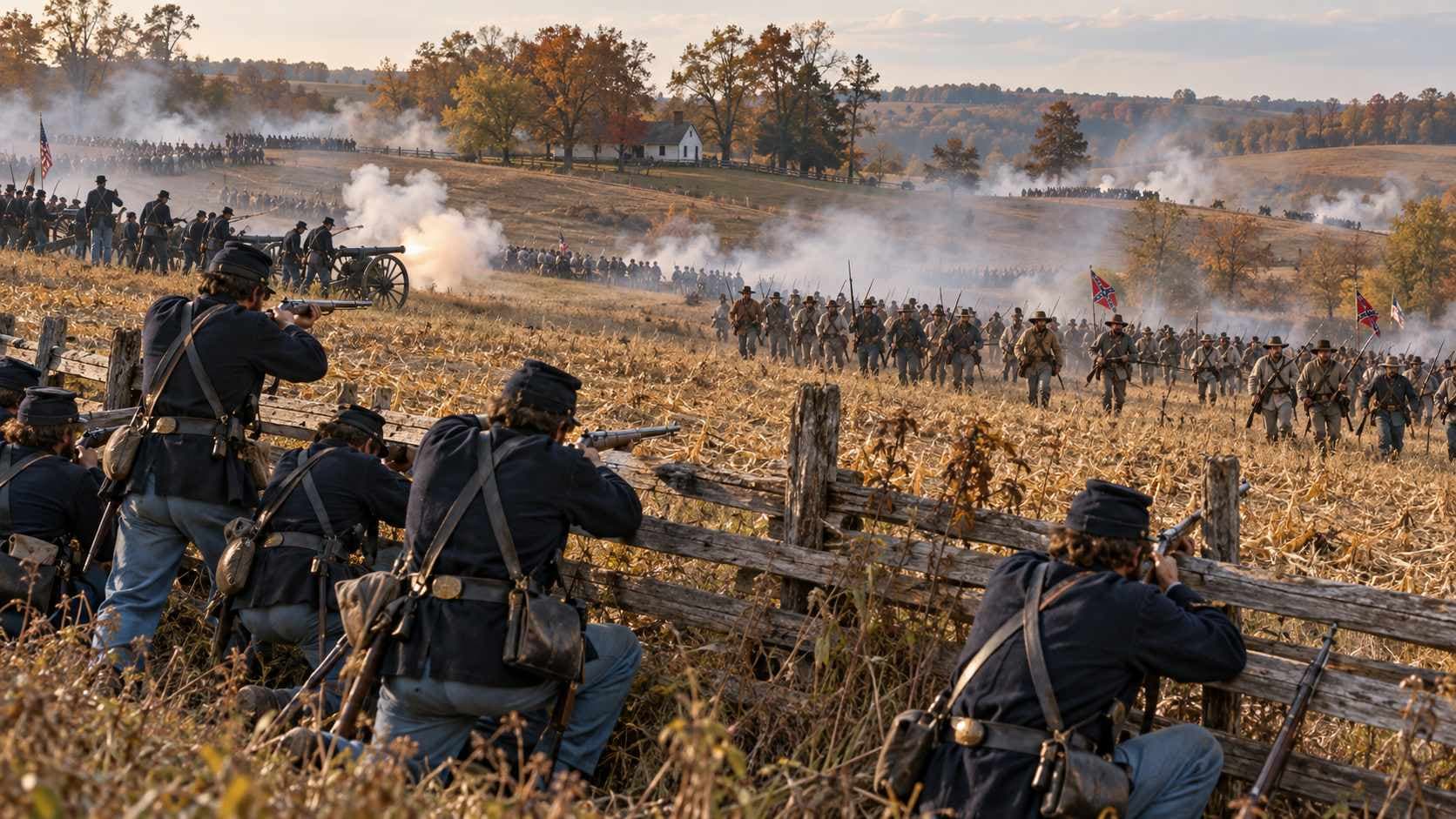
Confederate infantry struck Union formations on the left of Buell's line. Men fought across uneven fields, ridges and ravines, and some Union positions were driven back under intense pressure. Parts of the field changed hands before daylight faded. The fighting inflicted heavy casualties on both sides. The terrain mattered for artillery placement and for the ability of officers to see what was happening beyond their immediate front. A unit could be engaged in a desperate defense while soldiers relatively close by remained unaware of the full scale of the battle.
Why Bragg Left
The Confederate attack had won ground, but Bragg learned more about the strength of the army facing him. Staying to fight again risked an engagement against a more fully concentrated opponent. His troops withdrew after the battle and subsequently left Kentucky. The Union retained control of the state. This outcome makes Perryville a useful case for distinguishing a tactical result from a campaign result. Holding a patch of ground at the end of an attack did not make it possible for the Confederates to sustain their invasion.
What the Battlefield Preserves
The open landscape around Perryville helps explain why a map with a few arrows is inadequate. Folds in the ground, long approaches and separated positions shaped what each commander could see and what reinforcements could do in time. The scarcity of water that helped bring the forces together then mattered to wounded men and exhausted units. Perryville belongs in the history of the Civil War as a struggle over Kentucky, but it also shows how basic resources and incomplete information can determine where and how a major engagement begins.
Sources
Found an error? Send a correction. Read our editorial standards.