Valcour Island: A Defeat That Bought Time
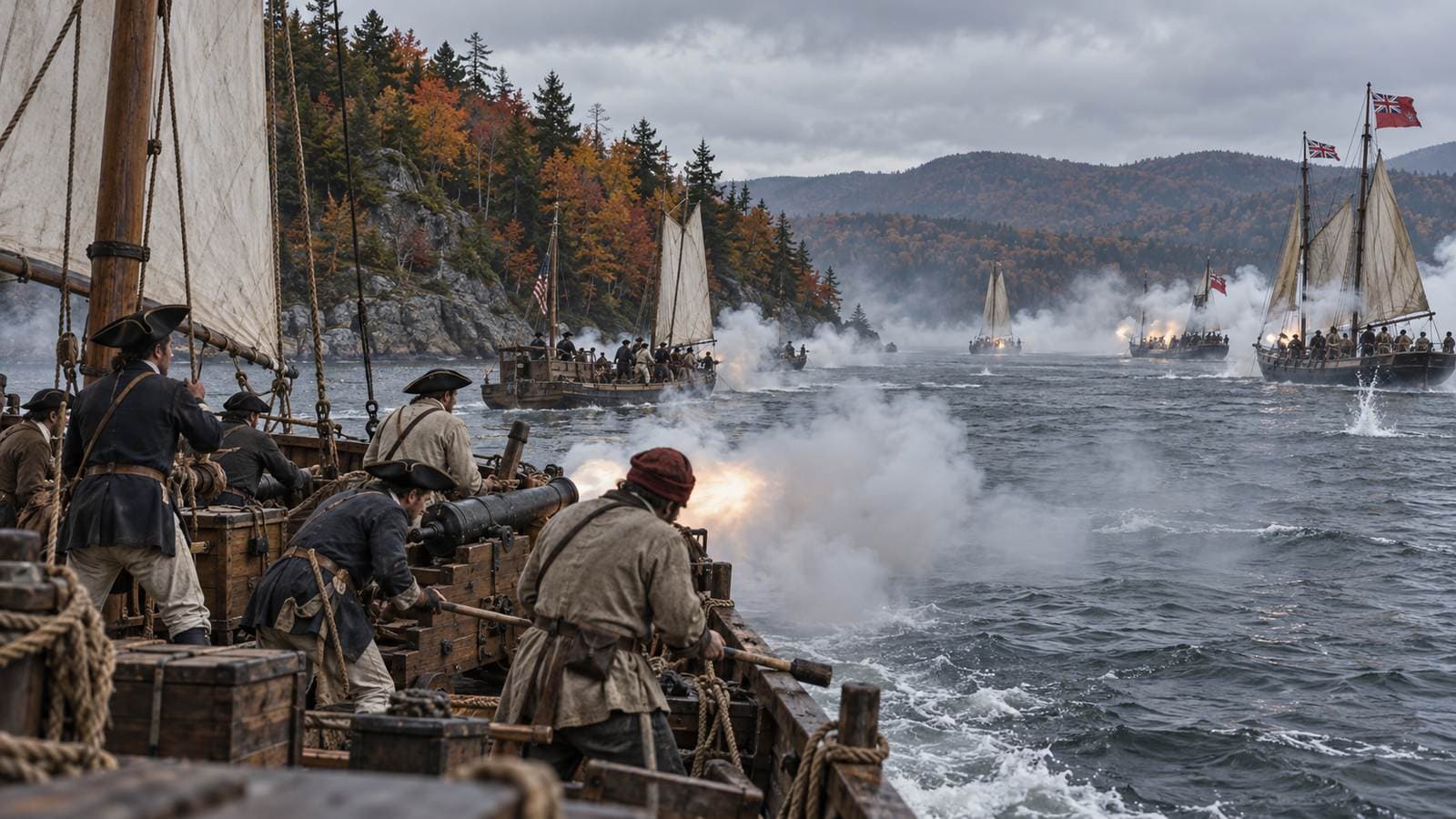
On October 11, 1776, British and American vessels met near Valcour Island on Lake Champlain. For an army operating between Canada and the Hudson Valley, the lake offered a route for men, provisions and artillery that could not readily be moved along forest trails.
Published · Updated · 3 min read
The Lake as a Military Road
On October 11, 1776, British and American vessels met near Valcour Island on Lake Champlain. For an army operating between Canada and the Hudson Valley, the lake offered a route for men, provisions and artillery that could not readily be moved along forest trails. The Americans had retreated from Canada earlier that year and were trying to keep a British advance away from Fort Ticonderoga. The fleet under Benedict Arnold was a means of making that advance slower and more costly, even if it could not permanently deny the British passage.
A Race to Put Boats in the Water
Both sides had to create or assemble much of the naval strength they needed on the lake. American shipbuilders worked at Skenesborough, at the southern end, while the British assembled a force at the northern end. Arnold used a mixture of schooners, row galleys and gunboats, many of them built for the campaign. British commander Guy Carleton had more powerful vessels available once his force was ready. The months spent assembling boats were already affecting the calendar before the guns opened. In this campaign, shipbuilding was part of delaying the enemy.
A Position Behind the Island
Arnold waited in the channel between Valcour Island and the New York shore. British ships coming south initially passed the position and had to turn back to engage. The choice of ground made it harder for the British to bring all their strength to bear at once, but it could not eliminate their advantage. The Americans suffered damage and lost vessels, including the gunboat Philadelphia, which sank after being hit. Its survival on the lake bottom eventually gave archaeologists a material record of how a hastily built Revolutionary vessel was armed and operated.
The Escape and Pursuit
In darkness Arnold's remaining vessels slipped away from the British. That maneuver prolonged the contest, but it did not save the fleet as an effective fighting force. The British pursued, more vessels were lost, and Arnold burned several to keep them from capture. Survivors reached American positions farther south. This was a British tactical victory. Calling it an American victory would obscure the destruction of Arnold's squadron and the fact that the British won control of the immediate waters.
The Limit Set by the Season
Carleton did not take Ticonderoga that autumn. With winter approaching, the British returned north, and a new invasion came in 1777. Weather, preparations and the remaining defenses all shaped that decision; the delay cannot be attributed to one gunboat or one afternoon alone. Valcour Island shows how the measure of an operation can differ at two levels. Arnold lost the ships he fought with, but the effort to build them and force a battle took time the invaders could not recover before the season ended.
Sources
- Revolutionary War (1775-1783) – Lake Champlain Maritime Museum — Lake Champlain Maritime Museum
- Valcour Island Battle Facts and Summary — American Battlefield Trust
- New York – Saving Spitfire: Shedding Light on the Battle of Valcour Bay from the Depths of Lake Champlain (U.S. National Park Service) — National Park Service
Found an error? Send a correction. Read our editorial standards.